English
 Español
 عربى
عربى








1.Introduction to AC Drives (Variable Frequency Drives) In the realm of modern industrial control an......
READ MOREHome / News / Industry News / Low-Voltage Soft Starter: How It Works, When to Use It, and How to Choose the Right One
Low-Voltage Soft Starter: How It Works, When to Use It, and How to Choose the Right One
Content
- 1 What a Low-Voltage Soft Starter Does and Why It Matters
- 2 How a Low-Voltage Soft Starter Works: The Technical Principle
- 3 Low-Voltage Soft Starter vs. DOL Starter vs. VFD: Choosing the Right Device
- 4 Key Parameters for Selecting the Right Low-Voltage Soft Starter
- 5
- 6 Low-Voltage Soft Starter Wiring and Installation Essentials
- 7 Commissioning and Parameter Configuration: Getting the Start Ramp Right
- 8 Soft Stop and Controlled Deceleration: An Underused Feature
- 9 Troubleshooting Common Low-Voltage Soft Starter Problems
- 10 Maintenance Best Practices for Long Soft Starter Service Life
What a Low-Voltage Soft Starter Does and Why It Matters
A low-voltage soft starter is an electronic motor control device that gradually ramps up the voltage supplied to an AC induction motor during startup — instead of applying full line voltage instantaneously as a conventional direct-on-line (DOL) starter does. By controlling the rate at which voltage rises from zero to full supply voltage, the soft starter limits the inrush current and mechanical shock that occur during motor startup, protecting both the motor and the connected mechanical load from the stresses associated with abrupt full-voltage energization.
When a standard induction motor is started across the line without any current limiting device, it draws an inrush current of typically 6 to 8 times its full-load rated current for several seconds until it reaches operating speed. In large motors, this spike can be 10 times full-load current or more. This surge stresses motor windings through resistive heating, creates intense torque shock on shaft couplings, gearboxes, belts, and driven equipment, and causes voltage dips on the supply network that can affect other connected loads and sensitive equipment sharing the same electrical infrastructure.
A low-voltage soft starter addresses all of these problems in a single compact device. Using a set of back-to-back thyristors (silicon controlled rectifiers, or SCRs) connected in each phase, it progressively increases the firing angle of the thyristors during the start sequence, which raises the RMS voltage delivered to the motor in a controlled ramp. The result is a smooth, adjustable acceleration that limits inrush current to a selectable multiple of full-load current, reduces mechanical shock to near zero, and eliminates the voltage disturbance on the supply network — extending motor life, protecting driven equipment, and reducing electricity demand charges simultaneously.
How a Low-Voltage Soft Starter Works: The Technical Principle
The core operating principle of an AC soft starter relies on phase-angle control of thyristors to regulate the voltage waveform delivered to the motor. In a standard three-phase soft starter, three pairs of back-to-back thyristors are connected in series with each of the three supply phases. Each thyristor pair controls one half-cycle of the AC waveform in its respective phase — one thyristor conducts the positive half-cycle and the other conducts the negative half-cycle.
During the start ramp, the soft starter's control electronics fire the thyristors progressively earlier in each half-cycle — a parameter called the firing angle or conduction angle. At the beginning of the ramp, the firing angle is large (thyristors fire late in the cycle), meaning only a small portion of each half-cycle is conducted and the effective RMS voltage reaching the motor is low. As the ramp progresses, the firing angle decreases (thyristors fire progressively earlier), conducting more of each half-cycle and increasing the effective voltage delivered to the motor. At the end of the start ramp, the thyristors are fired at the earliest possible point in each half-cycle, delivering nearly full supply voltage to the motor.
Once the motor has reached full speed, most modern low-voltage soft starters close an internal or external bypass contactor that connects the motor directly to the supply line, bypassing the thyristors entirely. This is an important feature because thyristors generate heat during conduction — running the motor continuously through the thyristors rather than bypassing them would require significant heat sinking and reduce the soft starter's lifespan. The bypass contactor eliminates this issue, allowing the soft starter to handle only the start and stop sequences while the motor runs at full efficiency on direct line supply during steady-state operation.
Low-Voltage Soft Starter vs. DOL Starter vs. VFD: Choosing the Right Device
One of the most frequently asked questions in motor control engineering is when to use a soft starter versus a direct-on-line starter versus a variable frequency drive. Each device has a distinct set of capabilities and limitations, and selecting the wrong one for an application leads to either over-engineering and unnecessary cost or under-specification and operational problems.
Direct-On-Line (DOL) Starter
A DOL starter connects the motor directly to the supply voltage when energized, with no current limitation. It is the simplest, cheapest, and most reliable motor starting method — but also the most disruptive. DOL starting is appropriate for small motors (typically below 5–7.5 kW depending on supply capacity), applications where the connected load can tolerate full-torque shock at startup, and systems where the electrical supply is robust enough to absorb the inrush current without significant voltage sag. For larger motors or sensitive applications, DOL starting is generally not acceptable from either a supply network or a mechanical durability standpoint.
Low-Voltage Soft Starter
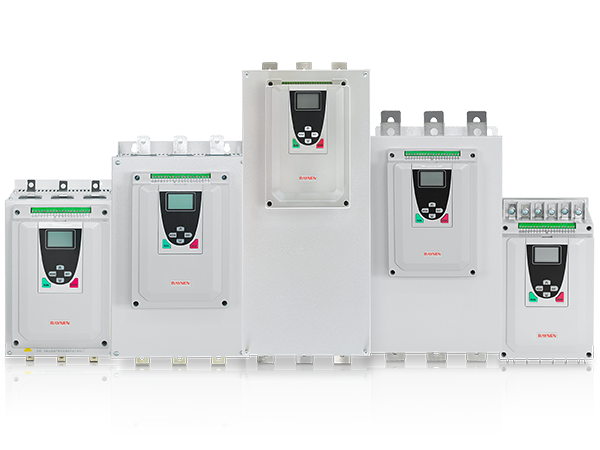
A low-voltage soft starter is the right choice when the primary requirement is to limit inrush current and mechanical shock during motor startup and stopping, but variable speed control during normal running is not needed. It is significantly less expensive than a VFD of equivalent rating, generates less heat, has lower harmonic distortion impact on the supply network during steady-state running (because the bypass contactor is closed), and is simpler to configure and commission. Soft starters are ideal for pumps, compressors, fans, conveyors, and any application where the motor runs at a fixed speed but requires controlled starts and stops.
Variable Frequency Drive (VFD)
A variable frequency drive provides full speed control throughout the motor's operating range — from zero to above base speed — by converting the incoming AC supply to DC and then synthesizing a variable-frequency, variable-voltage AC output. VFDs inherently provide smooth starting (often better than a soft starter) and also enable continuous speed adjustment during running, which enables major energy savings in variable-torque loads like pumps and fans through the affinity laws. However, VFDs are more expensive, generate significant harmonic distortion on the supply network, produce more heat, and are more complex to size, install, and maintain. The choice between a soft starter and a VFD comes down to whether variable speed control during running is required — if it is, a VFD is necessary; if it isn't, a soft starter is the more cost-effective and simpler solution.
| Feature | DOL Starter | Low-Voltage Soft Starter | VFD |
| Inrush Current Limiting | None | Yes (adjustable) | Yes (excellent) |
| Variable Speed During Run | No | No | Yes (full range) |
| Mechanical Shock at Start | High | Low | Very Low |
| Harmonic Distortion (Running) | None | None (bypass closed) | Significant |
| Relative Cost | Low | Medium | High |
| Energy Saving During Run | None | Minimal | Significant (variable loads) |
| Installation Complexity | Simple | Moderate | Complex |
Key Parameters for Selecting the Right Low-Voltage Soft Starter
Selecting a low-voltage soft starter correctly requires evaluating a set of technical parameters against your specific motor and application requirements. Undersizing leads to thermal overloading of the thyristors during start sequences; oversizing wastes capital and cabinet space. Working through the following criteria systematically ensures you specify a device that performs reliably throughout its service life.
Motor Rated Current and Voltage
The foundational sizing parameter for any soft starter is the full-load current (FLC) of the motor it will control, expressed in amperes. Soft starters are rated by their maximum continuous current-carrying capacity, and the selected device must have a current rating equal to or greater than the motor's FLC. The voltage rating of the soft starter must also match the motor's supply voltage — most low-voltage soft starters are rated for supply voltages in the range of 200–690V AC, 50/60 Hz, covering the standard low-voltage distribution levels used globally.
Starting Duty and Class
Not all starting applications impose the same thermal burden on a soft starter's thyristors. A pump that starts once per hour imposes a very different thermal duty than a conveyor that starts and stops every few minutes or a saw that starts under heavy load multiple times per hour. Soft starters are classified by their starting duty — typically expressed as a maximum number of starts per hour, a maximum starting current multiplier, and a maximum start duration in seconds. Applications with frequent starts, high starting current requirements, or long acceleration times require a soft starter with a higher duty class rating. Selecting a device based solely on motor FLC without considering starting duty is a common cause of premature thyristor failure in high-cycle applications.
Load Type: Torque Characteristics at Startup
The torque characteristic of the connected load significantly influences how the soft starter must be configured and whether a standard soft starter is appropriate at all. Centrifugal pumps and fans are low-inertia, low-starting-torque loads that are ideal for soft starters — they accelerate easily under reduced voltage and the load torque increases gradually as speed rises. High-inertia loads like large flywheels, ball mills, or heavily loaded conveyors require high starting torque that a standard soft starter may not provide — because reducing voltage reduces torque quadratically, a motor starting under reduced voltage may stall if the load torque is high enough. For high-starting-torque applications, a soft starter with a current boost or torque control feature, or alternatively a VFD, is required.
Built-In Protection Functions
Modern low-voltage soft starters incorporate a range of built-in protective functions that go beyond simple motor starting. The availability and sophistication of these functions vary significantly between basic economy models and full-featured units. When selecting a soft starter for a critical application, evaluate the built-in protection functions carefully against the motor and application protection requirements.
- Electronic overload protection: Continuously monitors motor current and trips the starter if current exceeds the overload threshold for a time inversely proportional to the excess — providing IEC Class 10, 20, or 30 trip characteristics selectable to match the motor's thermal time constant.
- Phase loss and phase imbalance detection: Detects the loss of one supply phase or significant current imbalance between phases — both of which cause rapid motor overheating and damage — and trips the starter before thermal damage occurs.
- Thermistor input: Accepts a signal from a PTC (positive temperature coefficient) thermistor embedded in the motor windings, providing direct motor temperature monitoring independent of current-based overload protection — valuable for motors subject to high ambient temperatures or poor ventilation.
- Stall and jam detection: Monitors for conditions where the motor is drawing high current but not accelerating to speed within the expected time (stall) or has been running but suddenly draws high current due to mechanical jam — protecting both the motor and the driven machine.
- Undervoltage and overvoltage protection: Trips the starter if supply voltage falls below or rises above defined thresholds, protecting the motor from operating under voltage conditions that increase current draw and heating.
Low-Voltage Soft Starter Wiring and Installation Essentials
Correct installation is as important as correct selection for reliable soft starter operation. The majority of soft starter field failures in the first year of service are attributable to installation errors rather than device defects — incorrect wiring, inadequate ventilation, incorrect parameter settings, and missing protective devices account for the overwhelming majority of early-life problems.
Standard In-Line Wiring Configuration
The most common soft starter wiring configuration connects the device in-line between the supply contactor and the motor terminals — the three supply phases pass through the soft starter's power terminals (typically labeled 1/L1, 3/L2, 5/L3 on the input side and 2/T1, 4/T2, 6/T3 on the output side) and then directly to the motor. An isolation contactor upstream of the soft starter disconnects the device from the supply during maintenance and provides short-circuit protection coordination. A bypass contactor is either built into the soft starter or installed externally in parallel with the power terminals — once the motor reaches full speed, the bypass closes and the motor runs direct-on-line while the soft starter's thyristors are taken out of circuit.
Inside-Delta Wiring Configuration
For large motors already connected in delta configuration, an inside-delta (or delta-internal) wiring arrangement connects the soft starter within the delta loop rather than in the main supply lines. This configuration reduces the current the soft starter must handle by a factor of 1/√3 (approximately 58%) compared to in-line wiring — allowing a smaller, less expensive soft starter to control a given motor. However, inside-delta wiring requires careful attention to phasing and is more complex to wire and commission correctly. It is commonly used for large motors above 200 kW where the cost saving from using a smaller soft starter justifies the additional wiring complexity.
Ventilation and Thermal Management
Low-voltage soft starters generate heat in their thyristors during every start sequence, and this heat must be dissipated to keep the device within its operating temperature range. Always observe the manufacturer's minimum clearance requirements above, below, and on the sides of the soft starter for adequate natural convection or forced air cooling. In enclosed control panels, calculate the total heat dissipation from all installed devices and verify that the panel's ventilation or air conditioning capacity is adequate to maintain the internal temperature within the soft starter's ambient temperature rating — typically 40°C to 50°C maximum. Exceeding the thermal rating during start sequences is the primary cause of thyristor degradation and premature failure.
Short-Circuit Protection Coordination
Thyristors are extremely fast devices that can be destroyed in milliseconds by short-circuit currents — far faster than a standard circuit breaker can interrupt. Soft starters must be protected by correctly coordinated short-circuit protective devices — either motor protection circuit breakers (MPCBs) or fuses — rated and selected according to the soft starter manufacturer's coordination table. Using an incorrectly selected protective device is one of the most common installation errors and can result in the soft starter being destroyed in a downstream fault event that a correctly specified device would have protected it from. Always consult the manufacturer's coordination data, not generic breaker sizing rules, when selecting upstream protection.
Commissioning and Parameter Configuration: Getting the Start Ramp Right
After physical installation, the soft starter must be configured with the correct parameter settings for the specific motor and load before first energization. Most low-voltage soft starters provide a set of adjustable parameters through a front-panel keypad and display or through communication interface software. The most critical parameters to configure correctly at commissioning are the start ramp settings and the motor overload protection threshold.
The initial voltage (also called the starting voltage or pedestal voltage) sets the voltage level at which the start ramp begins. Setting this too low means the motor initially produces insufficient torque to begin accelerating the load, causing the motor to stall at the beginning of the ramp. Setting it too high reduces the benefit of the soft start by beginning the ramp close to full voltage. For most centrifugal pump applications, an initial voltage of 30–40% of supply voltage is a practical starting point, adjusted based on the actual acceleration behavior observed during commissioning.
The ramp time (also called acceleration time) defines how long the voltage ramp from initial to full voltage takes. Longer ramp times produce gentler acceleration and lower peak inrush current, but also mean the motor spends more time at reduced voltage — increasing heating in the motor windings. Typical ramp times range from 3 to 30 seconds depending on load inertia and the acceptable level of inrush current. The overload current setting should be set to 100–105% of the motor's nameplate full-load current to ensure accurate overload protection without nuisance tripping during normal operation variations.
Soft Stop and Controlled Deceleration: An Underused Feature
Most attention in soft starter selection and commissioning focuses on the start sequence, but the soft stop function — controlled deceleration on shutdown — is equally valuable in many applications and is frequently overlooked or left disabled. When a pump or fan motor is switched off abruptly, the sudden loss of flow can cause water hammer in pumping systems (the hydraulic shock wave created when fluid momentum is abruptly stopped), pressure surges in pipeline systems, and mechanical stress on couplings and driven equipment as inertia is rapidly dissipated.
A soft starter's soft stop function progressively reduces the voltage to the motor over an adjustable deceleration ramp time — typically 1 to 20 seconds — allowing the motor and load to decelerate gradually rather than coast to a stop freely. In pump applications with long discharge lines, enabling soft stop with a deceleration time of 5–10 seconds virtually eliminates water hammer, protecting pipework, valves, and fittings from hydraulic shock damage. In conveyor applications, soft stop prevents product spillage from the sudden jerk of abrupt stopping. Enabling and correctly configuring soft stop is one of the easiest ways to extract additional value from an already-installed soft starter and is strongly recommended for any application where abrupt stopping creates mechanical or hydraulic issues.
Troubleshooting Common Low-Voltage Soft Starter Problems
Soft starters are robust electronic devices that rarely fail when correctly specified, installed, and maintained — but when problems do occur, they tend to fall into identifiable patterns with clear root causes. A structured troubleshooting approach using the fault codes displayed on the soft starter's panel combined with knowledge of the most common failure modes resolves the majority of field issues without requiring component replacement.
- Motor fails to start / trips immediately on start command: Check first for phase loss on the supply — a missing phase prevents the soft starter from building a balanced rotating magnetic field and will cause an immediate trip. Verify all upstream protective devices are closed and supply voltage is present and balanced on all three phases. If supply is confirmed, check that the motor overload current setting matches the motor's actual FLC — an incorrectly low overload setting will cause nuisance tripping during the high-current start ramp.
- Motor accelerates too slowly or stalls during start ramp: The initial voltage setting is too low for the load's starting torque requirement. Increase the initial voltage setting in 5% increments and re-test. Also verify that the load is not mechanically jammed — check that the driven equipment rotates freely before attributing slow acceleration to soft starter settings alone.
- Soft starter overheats / thermal fault trips: The most common cause is starting duty exceeding the device's rated capacity — too many starts per hour, too long a start duration, or too high a starting current for the thermal class of the unit. Check the actual number of starts per hour against the soft starter's rated maximum. Also inspect ventilation clearances and panel cooling — a blocked air inlet or undersized panel cooling system will cause thermal faults even within rated starting duty.
- Bypass contactor fails to close after start ramp: The motor may not be reaching full speed within the expected acceleration time — caused by excessive load inertia, a mechanical issue in the driven equipment, or too short a ramp time setting. If the motor does reach full speed, check the bypass contactor coil voltage and control circuit wiring. In soft starters with an internal bypass, contact the manufacturer if the bypass is not closing reliably after confirmed full-speed acceleration.
- Erratic or inconsistent starting performance: Intermittent starting problems that vary between starts often indicate a loose power connection creating intermittent contact resistance — check and re-torque all power terminal connections to the manufacturer's specified torque values. Oxidized connections at the motor terminals or in intermediate junction boxes are another common cause of inconsistent performance and should be inspected and cleaned as part of the initial troubleshooting process.
- Communication faults on fieldbus or network: Modern soft starters with Modbus, PROFIBUS, EtherNet/IP, or other communication options occasionally develop communication faults caused by incorrect termination resistors at the end of bus runs, incorrect node address settings, cable continuity issues, or electromagnetic interference from adjacent power cables. Verify bus termination, cable routing separation from power conductors, and node addressing before suspecting a hardware fault in the soft starter's communication module.
Maintenance Best Practices for Long Soft Starter Service Life
Low-voltage soft starters require relatively little maintenance compared to mechanical motor starting equipment — there are no contacts to replace, no moving parts in the power circuit, and no lubrication requirements. However, a modest periodic maintenance routine significantly extends service life and prevents the majority of avoidable failures.
The most important routine maintenance task is cleaning. Control panel environments accumulate dust and conductive contamination over time, and a layer of dust on the soft starter's heatsink fins dramatically reduces convective heat dissipation — the same thermal protection issue that causes thyristor degradation under heavy starting duty. Every 6–12 months (or more frequently in dusty industrial environments), power down the soft starter and use compressed dry air to blow dust from the heatsink, ventilation slots, and circuit boards. Inspect all power terminal connections and re-torque to specified values, as thermal cycling from repeated starts causes connections to loosen over time.
Review the soft starter's event log or fault history at each maintenance visit if the device has logging capability. A log showing increasing numbers of thermal warnings, phase imbalance events, or overload approaches before a full trip provides advance warning of developing problems — in the motor, the supply network, or the mechanical system — before they cause an unplanned production shutdown. Using the diagnostic data available from modern soft starters proactively is one of the most effective maintenance strategies available to operations and maintenance teams working with motor-driven equipment.
Previous Post
Electric Drive Explained: How It Works, Types, and Why It Matters
Next Post
Why an AC Servo Motor is the Brains Behind Modern Automation

Copyright 2024 Fujian Raynen Technology Co.,Ltd. All Rights Reserved.
Privacy Policy  Motor Control Manufacturers